The ChatGPT Moment for Robotics: Why Manufacturing’s Breakthrough Might Take Longer Than Expected
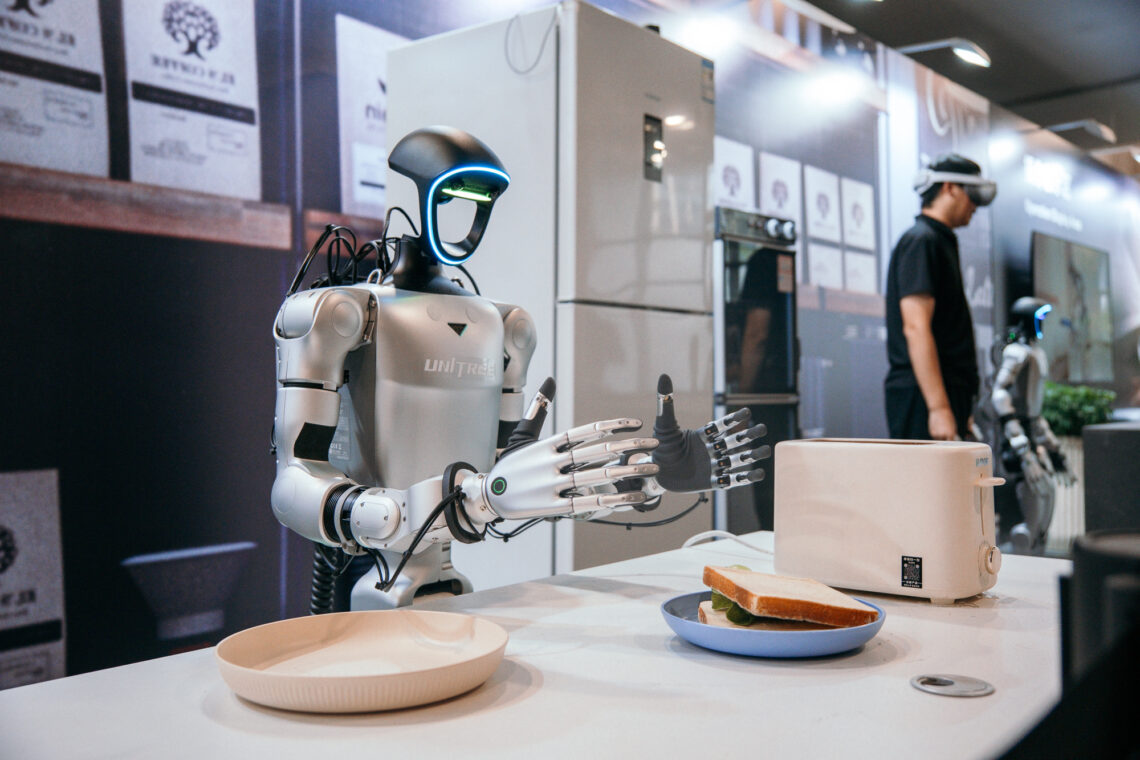
The Chinese manufacturer Unitree expects a major breakthrough in robot intelligence within one to two years. But more powerful AI alone does not yet make humanoid robots ready for the factory floor. Siddhanth Janadri, a robotics expert at the it’s OWL Initiative Stratosfare, explains why the biggest challenges now lie less in the hardware and more in dealing with an unpredictable physical world.
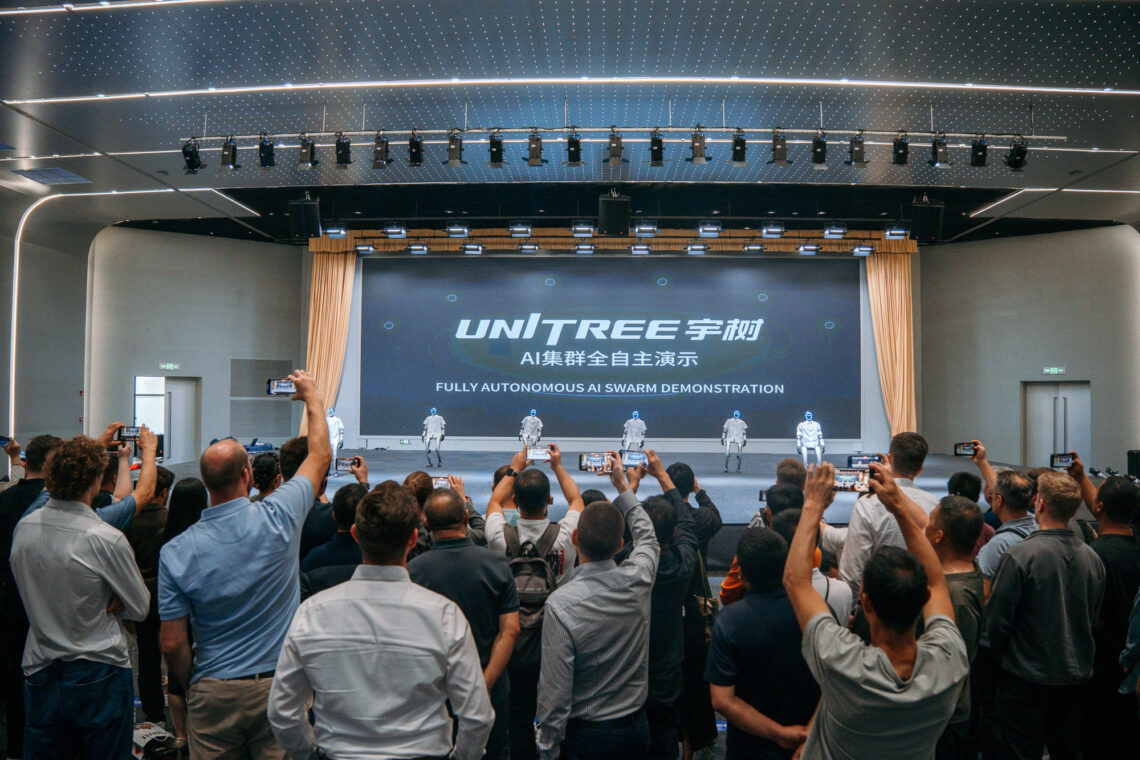
In one to two years, robotics could experience its “ChatGPT moment.” Wang Xingxing, founder of the Chinese robotics manufacturer Unitree, is convinced of this. On October 12, he stated in Shanghai that advances in artificial intelligence could pave the way for a fundamental technological breakthrough.
The forecast is ambitious. Wang had already described back in August what he would consider such a breakthrough: Robots would have to be able to perform a large portion of their tasks on their own in unfamiliar environments, guided solely by verbal instructions.
There is still a long way to go. The hardware has become more powerful, the movements are smoother, and the robots are increasingly capable of performing complex tasks. Whether these capabilities will function reliably under varying conditions, however, remains one of the biggest unanswered questions.
“Just because a robot can demonstrate a task doesn’t mean it can reliably perform it in a factory,” says Siddhanth Janadri, a robotics expert with the it’s OWL Initiative Stratosfare.
He considers the advances in hardware made by Chinese robotics manufacturers such as Agibot and Unitree to be remarkable. He now sees the key challenge as how well robots can handle situations for which they have not been specifically trained.

Why a robot might fail after a hundred successful attempts
A robot is being trained to take a container off a shelf and place it on a cart. The task works every time. Then something changes: The container is in a different position, is heavier, or has a different shape.
The robot must adjust its movements. To do this, it is not enough to simply recognize the object correctly. It must also assess where it can grasp the object, what forces are at work, and how the object behaves as it moves.
People usually handle such deviations without much difficulty. For robots, however, they are among the key challenges.
In research, this is referred to as generalization. It refers to the ability to apply what has already been learned to new situations. The demands are particularly high when it comes to handling objects. Friction, contact forces, and small changes in the environment can determine whether a movement is successful.
This poses a significant obstacle for factories. Workpieces vary, component positions change, and production lines must handle different variants. If a robot must undergo extensive retraining after every change, flexible automation loses some of its economic advantage.
Can a glimpse into the future make robots better?
A key question in robotics research is how machines can better respond to unfamiliar situations. To this end, companies and research institutions are investigating various AI architectures.
One important approach involves so-called vision-language-action (VLA) models. These models link visual information and verbal instructions to robot movements. This enables a system, for example, to recognize which object is being referred to and to perform the corresponding movement.
In addition, models that take greater account of how the physical environment might change as a result of an action are gaining importance. Such approaches are referred to, among other things, as world-action models. They combine the control of robot movements with predictions about possible future states.
The idea behind this is that if a robot can estimate how an object will respond to its grip, it could better adjust its movements and handle unfamiliar situations as well.
Whether this approach actually leads to more capable robots, however, remains an open research question. The ability to predict future states does not automatically mean that a robot will perform its tasks more reliably. Nor has it been conclusively determined yet under what conditions such models offer advantages over other AI architectures.
Several leading robotics companies are working on related issues. Unitree has released UnifoLM-WMA, an architecture that integrates world models with robot control. In September 2026, Agibot introduced GE-Act 2.0, another approach to AI-assisted robot control. NVIDIA is also researching methods—such as Cosmos Policy —that link robot movements to predictions about future states.
These approaches differ technically and should not necessarily be viewed as substitutes for VLA models. Rather, the companies are exploring different ways to make robots more adaptable.
Initial research findings show progress in specific test scenarios. However, it remains to be seen whether this will result in significant benefits for industrial applications. The key factor is how reliably the systems can handle unknown workpieces, changing environments, and unforeseen situations.
Train for every new task from scratch? That would be too expensive.
In addition to AI models, the way robots learn must also change.
At the Chinese manufacturer Agibot, specialized teams record movements and handling processes from various camera angles. The footage is reviewed and processed for training the AI models.
The effort involved is considerable. Unlike with language models, there are no vast repositories of pre-digitized information available for many movements and physical interactions. The necessary data often has to be generated from scratch.
“If thousands of movements have to be demonstrated for every new task, that’s not a sustainable solution in the long run,” says Janadri.
In his view, robots must be able to transfer their existing skills to other objects, tasks, and work environments with significantly less additional training in the future.
This also involves a different approach to errors. Until now, successful movement sequences have often been demonstrated and used as training data. In the future, robots will learn more from failed attempts, human corrections, and operational experience.
A failed grasp would then not just be a mistake that needs to be corrected. It could provide the system with information to help it execute the next movement more effectively.
For industrial companies, this would have an immediate economic benefit. The less data and development work required to prepare a robot for new tasks, the more likely it is that the technology could prove cost-effective even in production environments with varying product variants.
A breakthrough isn’t decided at a trade show
It remains to be seen whether Unitree’s forecast will come true in just one or two years. The progress being made in AI models shows just how intensively companies and research institutions are working on a new generation of intelligent robots. However, even more powerful AI does not automatically meet the demands of everyday industrial operations.
Further challenges remain for widespread industrial use. Robots must operate reliably over extended periods, meet safety requirements, and be capable of integrating into existing production facilities. Speed, maintenance requirements, and costs also determine whether they are economically viable compared to conventional automation.
“The real breakthrough will come when robots can detect errors, adapt their behavior, and learn from experience.”
Siddhanth Janadri, robotics expert at the it’s OWL Initiative Stratosfare
Janadri therefore distinguishes between a breakthrough in general robot intelligence and systems that operate autonomously and reliably over the long term in various industrial environments. It could take considerably longer to achieve the latter.
“The real breakthrough will come when robots can detect errors, adapt their behavior, and learn from experience,” says Janadri.
This would also set the standard for the next phase of robotics. The decisive factor will no longer be solely which movements a manufacturer can demonstrate at a trade show, but rather how well a robot performs when faced with a task it has never performed in exactly that form before.